

Export Is Not Internationalization: Why the Difference Matters for SMEs

Many SMEs confuse exporting with internationalization.
The two concepts are related, but they are far from being the same.
This misunderstanding often leads companies to invest significant resources in entering foreign markets without building the organizational foundations required for long-term success.
The result?
Initial sales may occur, but sustainable growth remains elusive.
What Is Export?
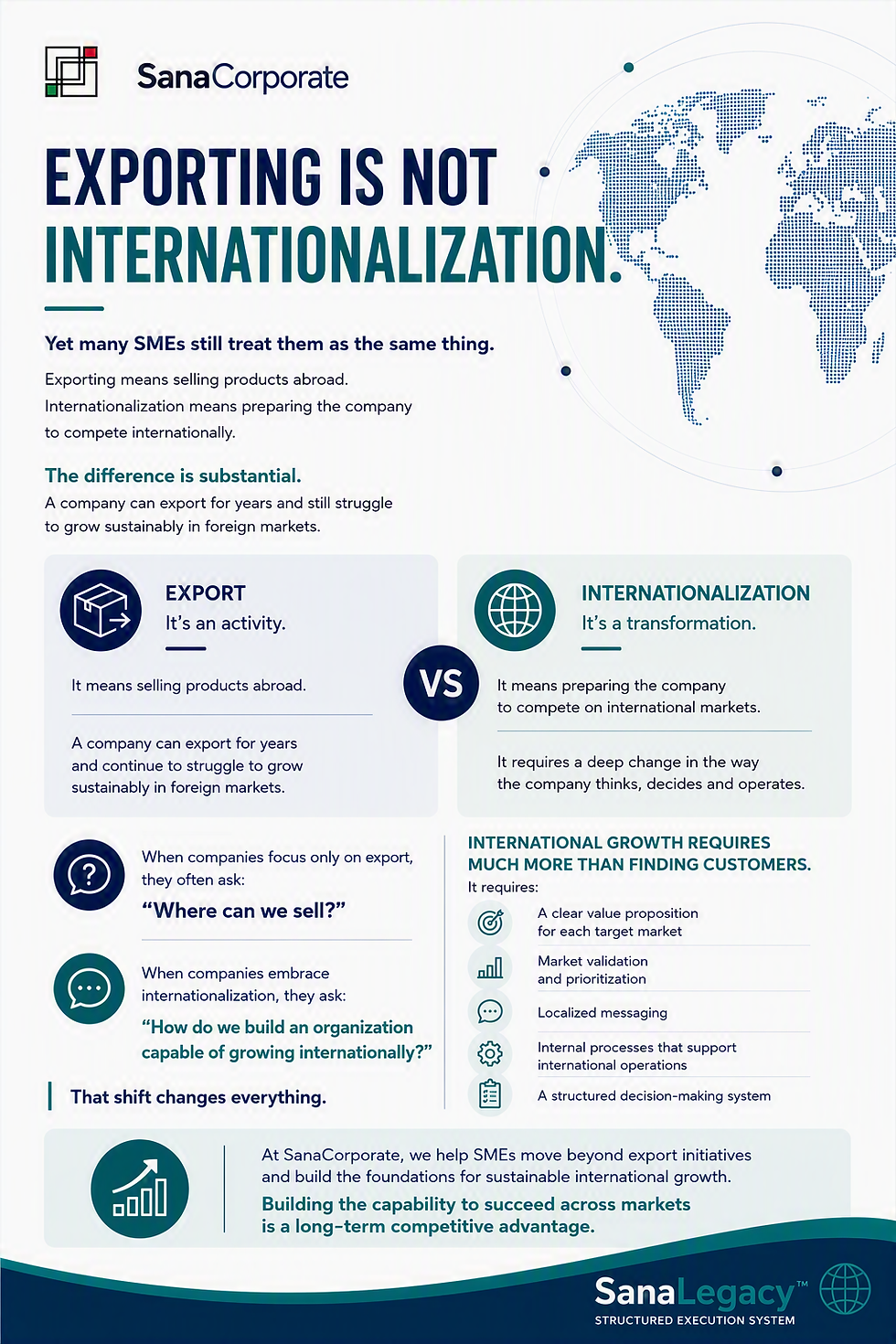
Exporting is the act of selling products or services to customers located in another country. Export is not Internationalization.
It is primarily a commercial activity.
A company identifies opportunities abroad, finds distributors, agents, partners, or customers, and begins generating sales.
Exporting focuses on questions such as:
Which countries should we target?
How can we find customers?
Which distributors should we work with?
How can we increase sales abroad?
These are important questions.
However, they represent only one part of the international growth journey.
What Is Internationalization?
Internationalization is the process of transforming an organization so that it can compete effectively in international markets.
It goes far beyond selling products abroad.
Internationalization requires a company to align strategy, operations, processes, people, communication, and decision-making around international growth objectives.
Rather than asking:
"Where can we sell?"
Internationalized companies ask:
"How do we build an organization capable of succeeding across multiple markets?"
This shift in perspective changes everything.
Why Export Alone Is Not Enough
Many SMEs successfully start exporting but encounter the same recurring challenges:
Lack of Market Prioritization
Resources are spread across too many markets without a clear rationale.
Generic Value Propositions
The company's message fails to resonate with local customer needs.
Limited Market Validation
Expansion decisions are often based on assumptions rather than evidence.
Operational Constraints
Internal processes are not designed to support international operations.
Fragmented Decision-Making
Information exists across spreadsheets, emails, conversations, and reports, making strategic decisions difficult.
These issues are not export problems.
They are internationalization problems.
Export vs. Internationalization
Export | Internationalization |
Activity | Transformation |
Focus on sales | Focus on organizational capability |
Market entry | Sustainable market development |
Transaction-driven | System-driven |
Short-term opportunities | Long-term competitive advantage |
Customer acquisition | Organizational readiness |
Export creates revenue opportunities.
Internationalization creates competitive capabilities.
The most successful companies understand both.
Building International Growth Requires a System
Sustainable international growth rarely happens because a company finds a single successful market.
It happens because the organization develops a repeatable way of identifying opportunities, validating them, making better decisions, and executing consistently.
This requires:
Clear positioning
Market validation
Opportunity prioritization
Localized communication
Operational alignment
Structured execution
Without a system, international growth becomes reactive.
With a system, international growth becomes repeatable.
How SanaLegacy Supports Internationalization
At SanaCorporate, we created SanaLegacy™ to help SMEs move beyond isolated export initiatives and build the foundations for sustainable international growth.
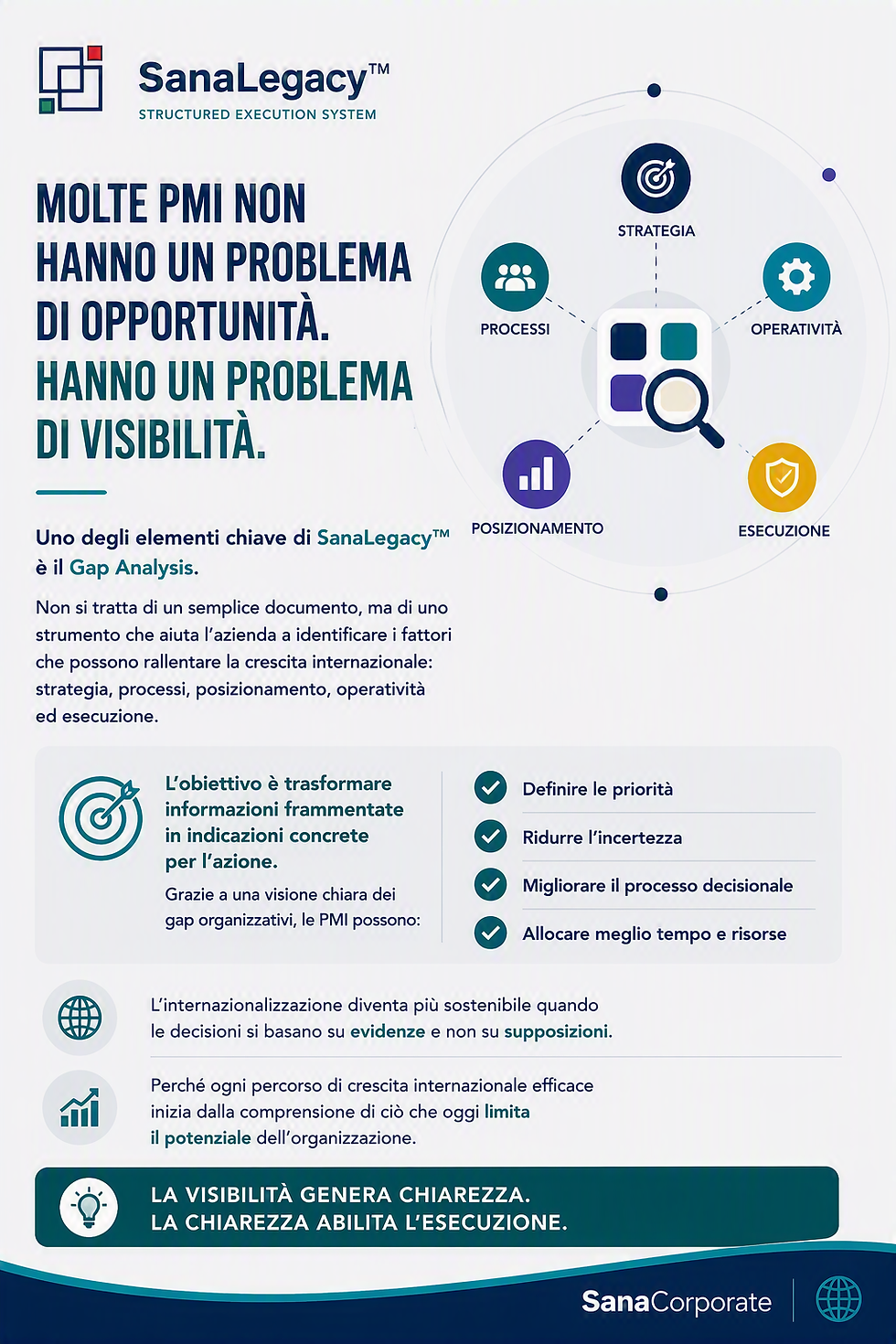
SanaLegacy transforms fragmented information into structured execution.
By collecting organizational signals, identifying strategic gaps, and connecting insights to action, companies can make more confident decisions and build a repeatable international growth capability.
The objective is not simply to help companies enter new markets.
The objective is to help companies become organizations that are ready to succeed in them.
Conclusion
Exporting helps companies sell internationally.
Internationalization helps companies compete internationally.
The distinction may seem subtle, but it often determines whether international growth remains an opportunity or becomes a sustainable competitive advantage.
Export is an activity.
Internationalization is a transformation.
And successful growth starts when organizations understand the difference.


Comments