

Export Opens Markets. Internationalization Builds Businesses.

Why Exporting and Internationalization Are Not the Same Thing
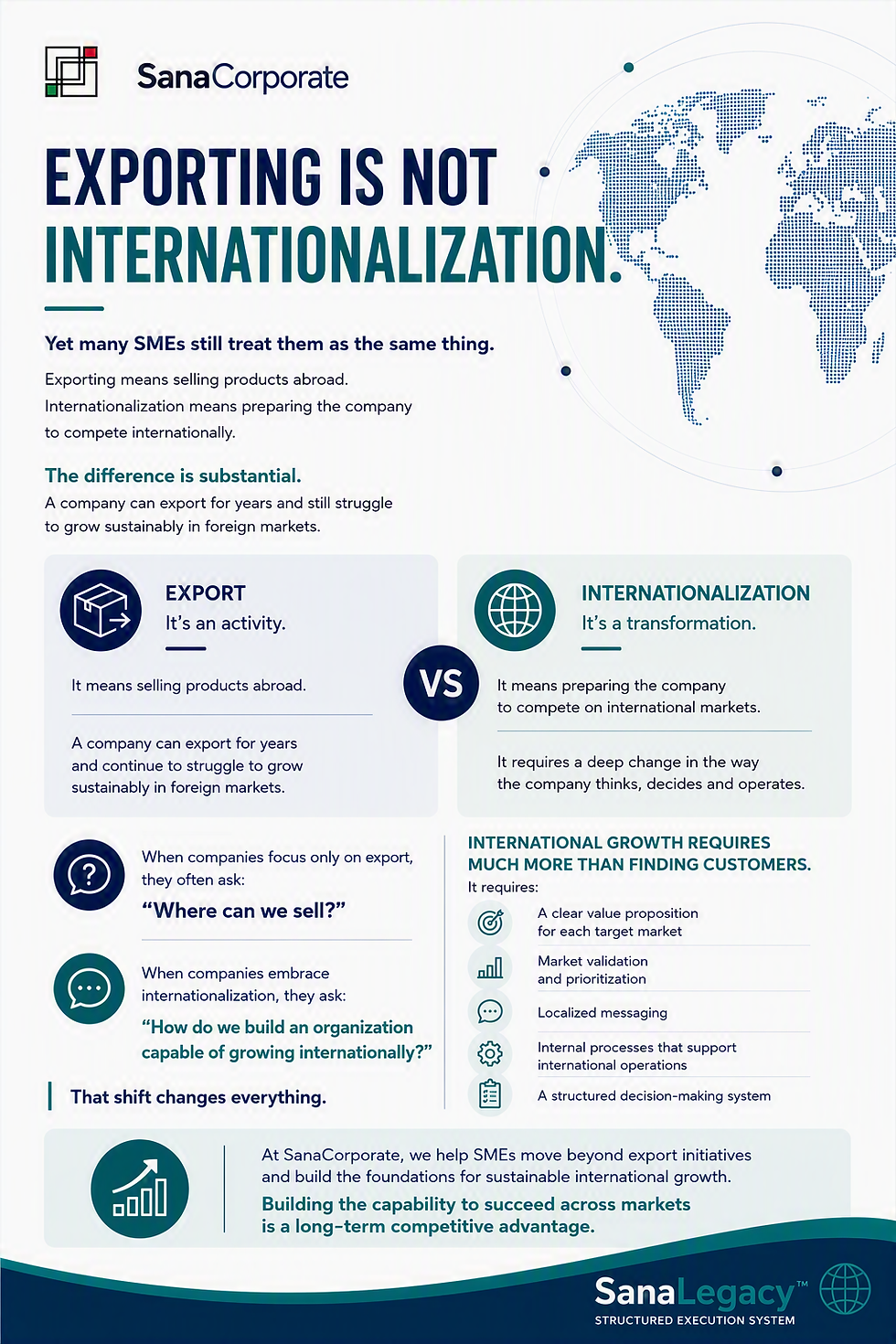
Many companies use the terms export and internationalization as if they mean the same thing.
They do not.
A company can export for years and still not be truly internationalized.
At first glance, the difference may appear subtle.
In reality, it can determine whether international growth becomes sustainable or eventually reaches its limits.
What Export Really Means
Exporting primarily focuses on sales.
It is about:
Finding customers
Generating orders
Entering new markets
Increasing international revenue
For many businesses, export is the first step in their international journey.
It creates opportunities.
It opens new doors.
And it allows companies to test foreign markets with relatively limited investment.
But exporting alone does not transform the organization.
It simply extends commercial activity beyond national borders.
What Internationalization Really Means
Internationalization goes much further.
It requires a company to adapt its organization to compete successfully in different markets.
Different markets bring:
Different customer expectations
Different buying behaviors
Different competitive landscapes
Different regulatory environments
Different ways of creating value
Internationalization is not simply about selling abroad.
It is about building an organization capable of succeeding abroad.
The Difference Between Transactions and Capabilities
One of the most important distinctions is this:
Export generates transactions.
Internationalization develops capabilities.
A company focused only on export may achieve sales growth.
A company focused on internationalization develops the structures, processes, and competencies needed to support long-term growth across multiple markets.
These capabilities often include:
Stronger market positioning
More resilient customer relationships
Better understanding of local market needs
Improved organizational adaptability
Over time, these capabilities become a competitive advantage.
Why Many Companies Struggle Internationally
Many organizations invest heavily in:
Trade fairs
Distributor searches
Sales visits
Market promotion
Yet they dedicate less time to understanding how their organization must evolve to support international growth.
The result is often predictable.
Activity increases.
Sales opportunities appear.
But sustainable growth remains difficult.
The challenge is not always finding customers.
The challenge is building a company capable of serving those customers consistently across different markets.
Internationalization Is an Organizational Transformation
Companies that succeed internationally rarely rely on product quality alone.
They adapt.
They learn.
They develop local market understanding.
They strengthen internal capabilities.
They build systems that support growth across multiple countries.
Internationalization is therefore not simply a commercial activity.
It is an organizational transformation.
A Final Observation
Many companies export.
Far fewer internationalize.
The difference matters.
One approach focuses on generating sales.
The other focuses on building an organization capable of sustainable international success.
Export opens markets.
Internationalization builds businesses.
SanaLegacy™
Trasforma le tue attività di export in un sistema strutturato per la crescita internazionale


Comments