

Internationalization vs exporting

Reflections After 35 Years in International Business
One of the most common misconceptions I encounter is the belief that Internationalization vs exporting are the same thing.
They are not.
A company can export for years and still not be truly internationalized.
At first glance, the difference may seem subtle.
In reality, it can determine whether international growth becomes sustainable or eventually reaches its limits.
The Export Illusion
Many companies start exporting and immediately believe they have become international. In reality, they have only crossed a border.
A distributor contacts them.
A customer discovers their product.
An opportunity emerges.
Soon, products start crossing borders.
The company is exporting.
This is often an important milestone.
But it is only the beginning.
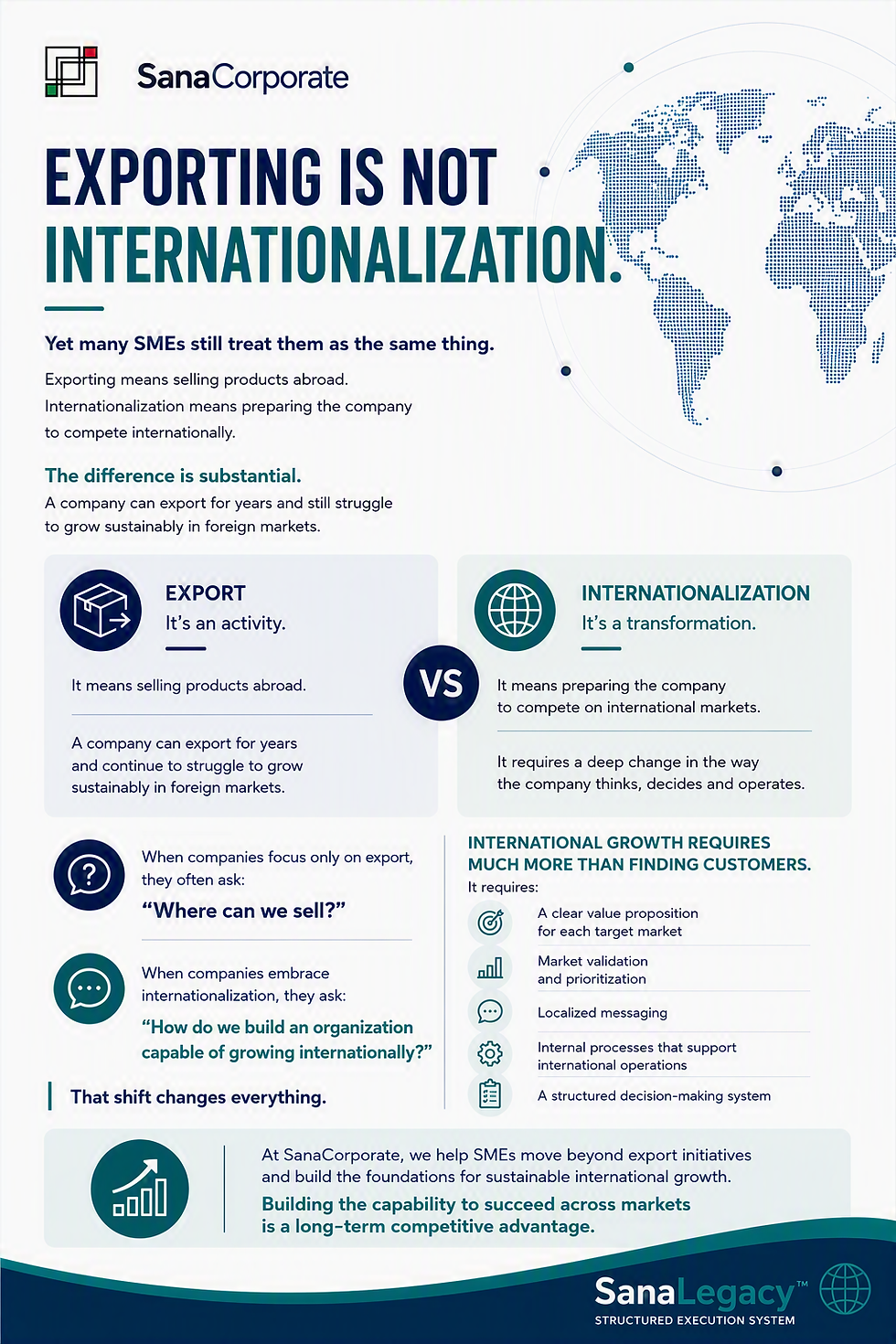
Exporting is primarily a commercial activity.
It answers a simple question:
Can we sell our products abroad?
Internationalization asks a different question:
Can our organization compete abroad consistently and sustainably?
Export Is a Transaction
Exporting focuses on sales.
Finding customers.
Generating orders.
Managing shipments.
Entering new markets.
There is nothing wrong with this.
In fact, it is often the necessary first step.
But exporting alone does not transform the business.
A company can export to ten countries while maintaining the same mindset, structure, and processes it uses domestically.
Sooner or later, limitations begin to emerge.
Internationalization Is a Transformation
Internationalization goes much deeper.
It requires adaptation.
Different markets have different expectations.
Different cultures have different ways of building trust.
Different customers evaluate value differently.
What works in one country may not work in another.
Internationalization requires companies to adapt:
Their organization
Their communication
Their decision-making
Their processes
Their relationships
In other words, internationalization is not about changing markets.
It is about changing the organization's ability to serve those markets.
What I Have Observed Over 35 Years
The companies that succeed internationally over the long term are rarely those that simply generate the most export sales.
They are the companies that learn.
They adapt.
They build local understanding.
They develop relationships.
They create structures capable of supporting growth across multiple markets.
They understand that international business is not just about crossing borders.
It is about bridging differences.
Why Growth Often Slows Down
Many companies invest heavily in finding customers.
Far fewer invest in becoming the kind of organization capable of serving those customers consistently.
This is often where growth slows down.
The challenge is not always the market.
The challenge is the organization's readiness to compete within that market.
A Final Observation
Over the years, I have met companies exporting to ten or more countries that still struggled to adapt their products, communication, or internal processes to those markets.
Exporting opens markets.
Internationalization builds businesses.
The first creates transactions.
The second creates capability.
SanaLegacy™
After 35 Years of Observations


Comments